
Easter eggs that can´t be eaten
(And other literary games)

I spent Easter weekend hunting Easter eggs – not the kind you eat, but those you find in books. I learned only recently (embarrassingly recently, if truth be told) that a little game I´ve been playing with myself for the past three decades as I write my novels, has a name. And the name of the game is hiding Easter eggs.
Literary Easter eggs (broadly defined as intentionally obscure references, the meaning of which the reader can only uncover with specialised knowledge or research) have probably been around for as long as we´ve had literature. Acrostic poems, in which the first letter or syllable or word of each new line spells out a word or message, can be seen as examples. But the phrase `Easter egg´ to describe this device comes from the early days of video games.
Apparently a programmer named Warren Robinett, frustrated by the fact that the company Atari didn´t credit the designers of the games, hid his name in a secret chamber of the 1979 game Adventure. When a teenage player wrote to Atari after discovering the message (Created by Warren Robinett), the company realised that it would be too expensive to remove the code. This was a problem, until another designer, Steve Wright, suggested they keep it and even encourage further hidden messages, because for the players it would be as exciting as discovering hidden Easter eggs.
Voilà, a phrase was coined, but it took another decade or two until the geek culture of gamers became mainstream enough for the term to be adopted by literary critics and viewers. Before the early 2000s, many novelists regarded the references they were hiding in their work simply as inside jokes. Or subtext, for the more academically minded. For me it was mainly a little fun to lighten up the long and lonely stretches of writing.
Before I give you a few examples, I have to confess that my other activity during the past weekend was burrowing down a rabbit hole of internet research to find the origins of this and other literary terms. (Or perhaps I should call it a bunny hole, to stay with the Easter theme.) I shouldn´t have been surprised to learn that `Easter eggs´ had been found on screens before they appeared in books. `MacGuffins´, after all, had become part of movie culture long before we started spotting them in literature.
It was the great director Alfred Hitchcock (or one of his screen writers, according to some sources found in my internet rabbit hole) who first used this Scottish surname for the typically irrelevant objects or devices planted in his movies to motivate the characters and move along the plot. For instance the stolen money that drives the actions of the female protagonist in Psycho – and indirectly leads to her death in that terrifying shower scene. This is what Hitchcock would have called a `pure MacGuffin´, vitally important to the character, but vague, even meaningless, to the average viewer. Famous MacGuffins from other famous directors include the falcon in John Huston´s The Maltese Falcon, the meaning of `Rosebud´ in Orson Welles´ Citizen Kane, and The Dude´s ruined rug in Ethan and Joel Coen´s The Big Lebowski.
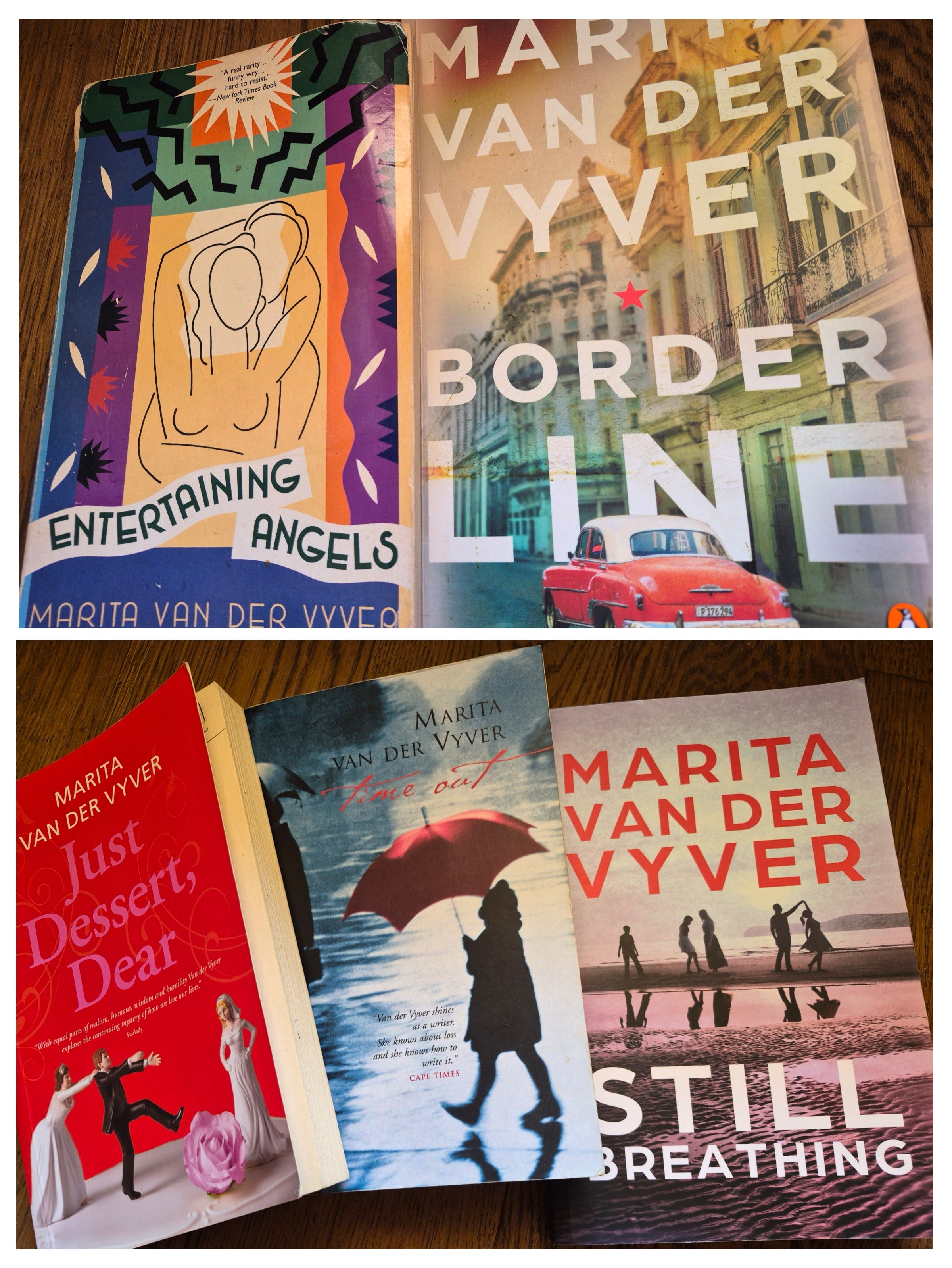
But there are countless pure and less pure MacGuffins in movies and books, ranging from The Ring in Lord of the Rings to Dorothy´s red slippers in The Wizard of Oz. I have even used MacGuffins in my own books - or so I´ve been informed. In Borderline (Grensgeval in Afrikaans) the female protagonist discovers a letter written by a Cuban soldier in the Angolan-South African war of the 1970s, which leads her on a wild goose chase all the way to Cuba, forty years after the letter was written.
`Nice MacGuffin,´ a clever male reader told me. `Is it a MacGuffin?´ I asked, flabbergasted. `I thought it was just a letter.´ No, it´s a MacGuffin, he insisted, because the contents of the letter is not revealed until right at the end. Like the last scene in Citizen Kane when you see Kane´s childhood sleigh with the name Rosebud painted on it. Although I was flattered by the Orson Welles comparison, I´m still not totally convinced that the letter was a MacGuffin. (Perhaps this conversation gave me just another example of mansplaining rather than an example of a MacGuffin.)
On the other hand, I´ve been blissfully unaware that I´ve been hiding Easter eggs in my work ever since my first adult novels were published thirty years ago, so I suppose I might also have been creating the odd MacGuffin without knowing what I was doing?
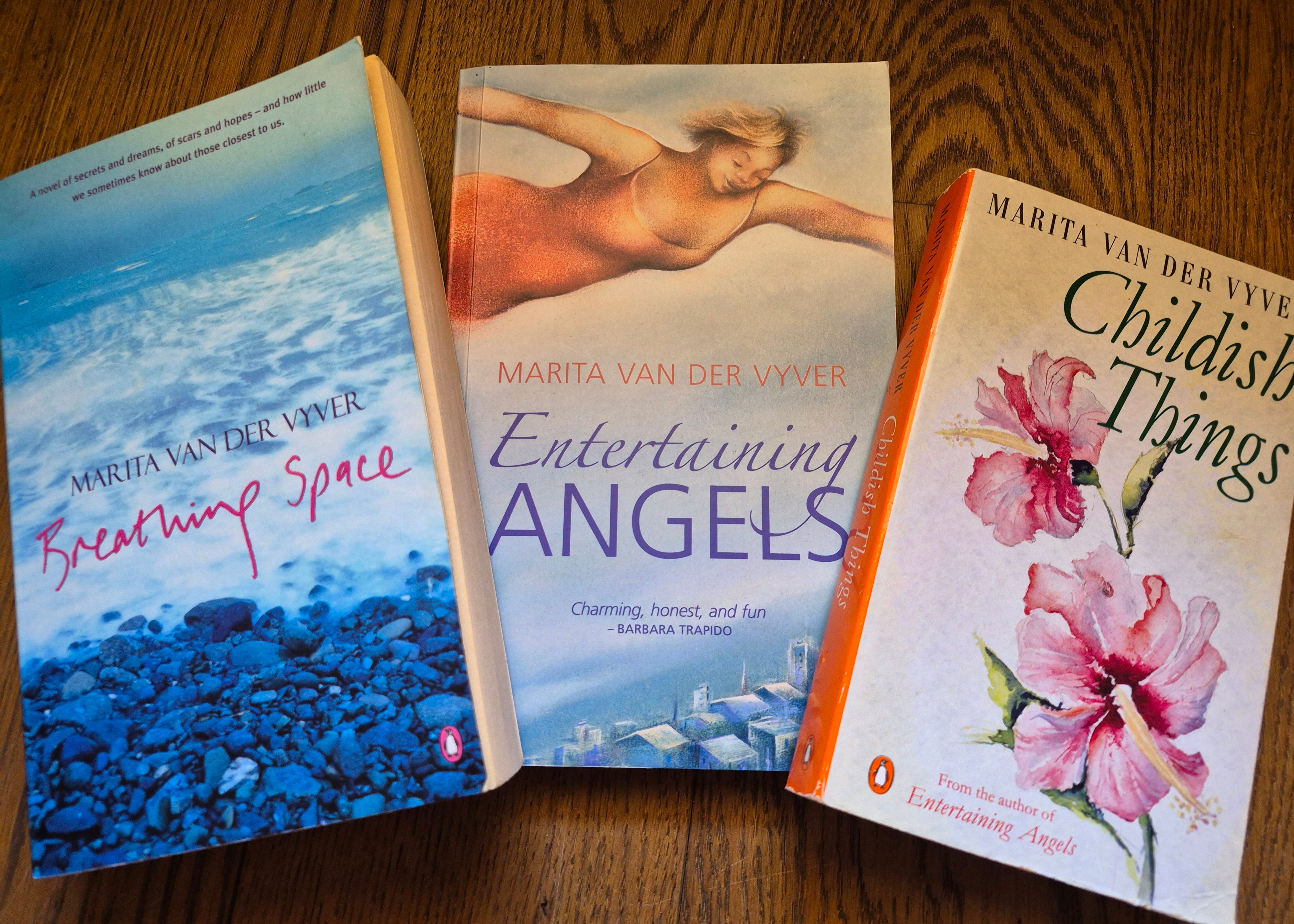
My favourite Easter eggs are frequent cameo appearances by characters from older books when I write a new book. The usual suspect is Griet Swart, eponymous heroine of my first adult novel, Griet skryf ´n sprokie (translated as Entertaining Angels) in 1992. It all started when she popped up as a guest at more than one party held by the group of friends who are the main characters in Breathing Space (Wegkomkans) in 1999, and then she featured in the dreams that Hester Human was writing down in Time Out (Stiltetyd) in 2006, and then she became one of the friends to whom Clara Brand wrote letters in the epistolary novel Just Dessert, Dear (Dis koue kos, skat) in 2010.
There were other appearances too, but I didn´t have the time to search for Griet in all my books over the Easter weekend. I do remember that in my last novel, Still Breathing (Laaste kans), published in 2023, she writes a letter from Italy which is read aloud at Adriaan´s 70th birthday party. Perhaps this is simply a lazy way of keeping regular readers up to date of what´s been happening in Griet´s life ever since she met the Italian Luca in Travelling Light (Griet kom weer) in 2002 – without having to go to the trouble of writing another follow-up book.
But then how do I explain that I´ve been doing it with other characters too, from early on, and that most of them are not as easily recognisable as Griet? Mart Vermaak from Childish Things (Dinge van ´n kind) has cameo appearances in at least three later novels – which I won´t name, because the whole point of an Easter egg hunt is that you should search for the eggs, isn´t it? Sometimes obscure cameo characters from one novel become more important characters in a later novel, and when I hide such an Easter egg I know that ninety percent of readers will never find it - which hopefully makes it more rewarding for the small number of dedicated readers who can connect the dots.
I never warn readers about these `inside jokes´ when I´m promoting a new book. When you explain an inside joke to half the world, you take away half the fun. But since I´m now writing about it, for the first time ever, I might mention that there´s a married couple named Anton and Sandra who are minor characters in Entertaining Angels, while in Borderline, written a quarter of a century later, the protagonist´s middle aged sister is named Sandra, who used to be married to a guy called Anton... I´ll just leave it there and let you draw your own conclusions, dear reader.
The closest I can come to an explanation for all these cross references, apart from the fleeting moments of private pleasure they provide during the long haul of novel writing, is that I´m creating a fictional universe, from book to book, peopled by fictional friends and acquaintances and friends of friends who grow older in real time, as I do. And when the real world gets me down, as happens all too often nowadays, I can escape to this parallel universe where I can empathise with absolutely everyone, despite knowing their darkest secrets and their foulest deeds. If only real life worked like this, hey?
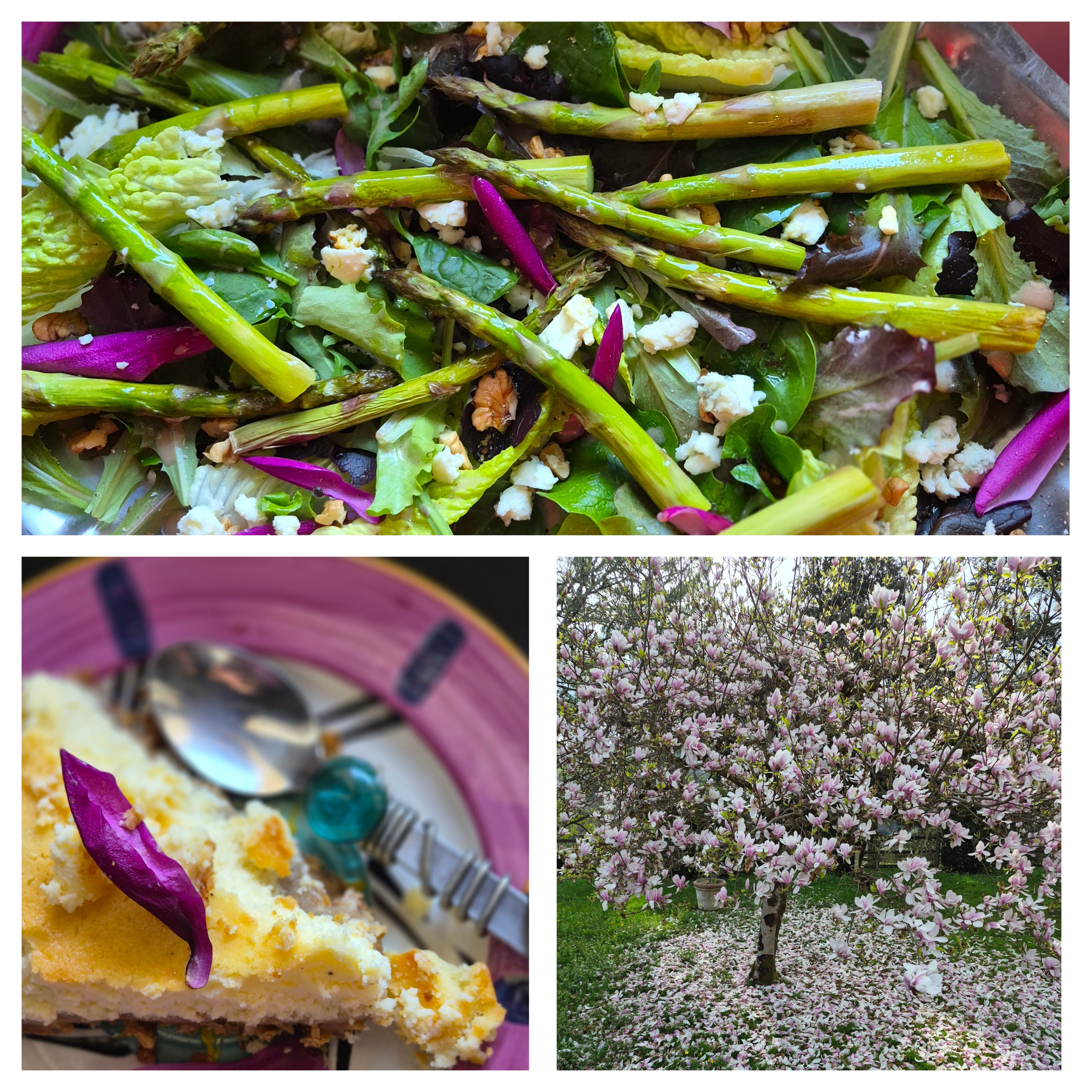
Taste of the week: Not Easter eggs, as you might expect. In fact, I passed Easter weekend without eating a single chocolate egg. I did enjoy a few bites of very dark chocolate, as I do almost daily, but I stayed away from the ridiculously expensive commercial eggs. I did, however, taste the first slender green asparagus of the season, grilled in the oven and served on a bed of mixed salad leaves. The detail that transformed the dish, not only visually, was the purplish pink magnolia petals which I scattered on the salad.
I was today years old, as they say on social media, when I discovered that you could eat magnolia petals. And since this is the season when magnolia trees bloom magnificently all over the countryside, the forager in me couldn´t resist trying out a new flower flavour. The asparagus and magnolia salad was such a success that I also decorated a Philadelphia cheese cake with these mauve petals. This turned into another tasty example of culinary culture mixing: American cheesecake baked by a Frenchman and decorated by a South African with petals from a tree originating in Asia and South America.
Sound of the week: I thought it would be the bells of the village church pealing on Easter Sunday, because in France this joyous ringing has a fascinating backstory. It is believed that the bells, rather than those silly Easter bunnies, bring the Easter eggs. (Although the international bunny culture seems to be overtaking the Catholic bell culture, even in France.) Still, children used to be told that all the church bells flew to Rome on Maundy Thursday (the day before Good Friday) and after being blessed by the Pope they all flew back home three days later, scattering sweets in gardens and on balconies along the way. So the ringing of the bells on Easter Sunday became the starting gun for Easter egg hunts all over France.
But the best sound I heard all week was very loud French hip-hop music blaring in our living room. Not that I´m a fan of hip hop (even less of French hip hop), but this noise meant that there was finally a door-size hole in the outer wall to give us access to our future courtyard. Which is still a work in progress, but at least there´s progress, even if it means the builders are now inside our little house and we can´t escape the music they play at deafening volume. (They have to play it this loud to hear it above the noise of breaking down a part of an impressively thick stone wall.) So I´m trying not to complain, really.
I´m even trying to listen to the lyrics of some of the songs, since I can´t concentrate enough to write anything. (This post is written in the evening after the hip hop has quieted down.) A song by Bigflo & Oli has an amusing opening line comparing the shape of the girls of Bordeaux to the famous rum-filled pastry of that city. The canelé of Bordeaux is a small striated cylinder with a depression at the top. I´m not sure I would take the comparison as a compliment if I were a girl from Bordeaux – but it´s still one of the more original lines among all the senseless lyrics I was forced to listen to this week.
Sight of the week: There is just something about a home-made swing hanging from the branch of an old tree that takes me back to my childhood. The irony is that I can´t remember ever swinging on such a swing as a child. I grew up in the suburbs with mass-manufactured swings and merry-go-rounds in parks. Perhaps it is the picture of an imagined childhood.
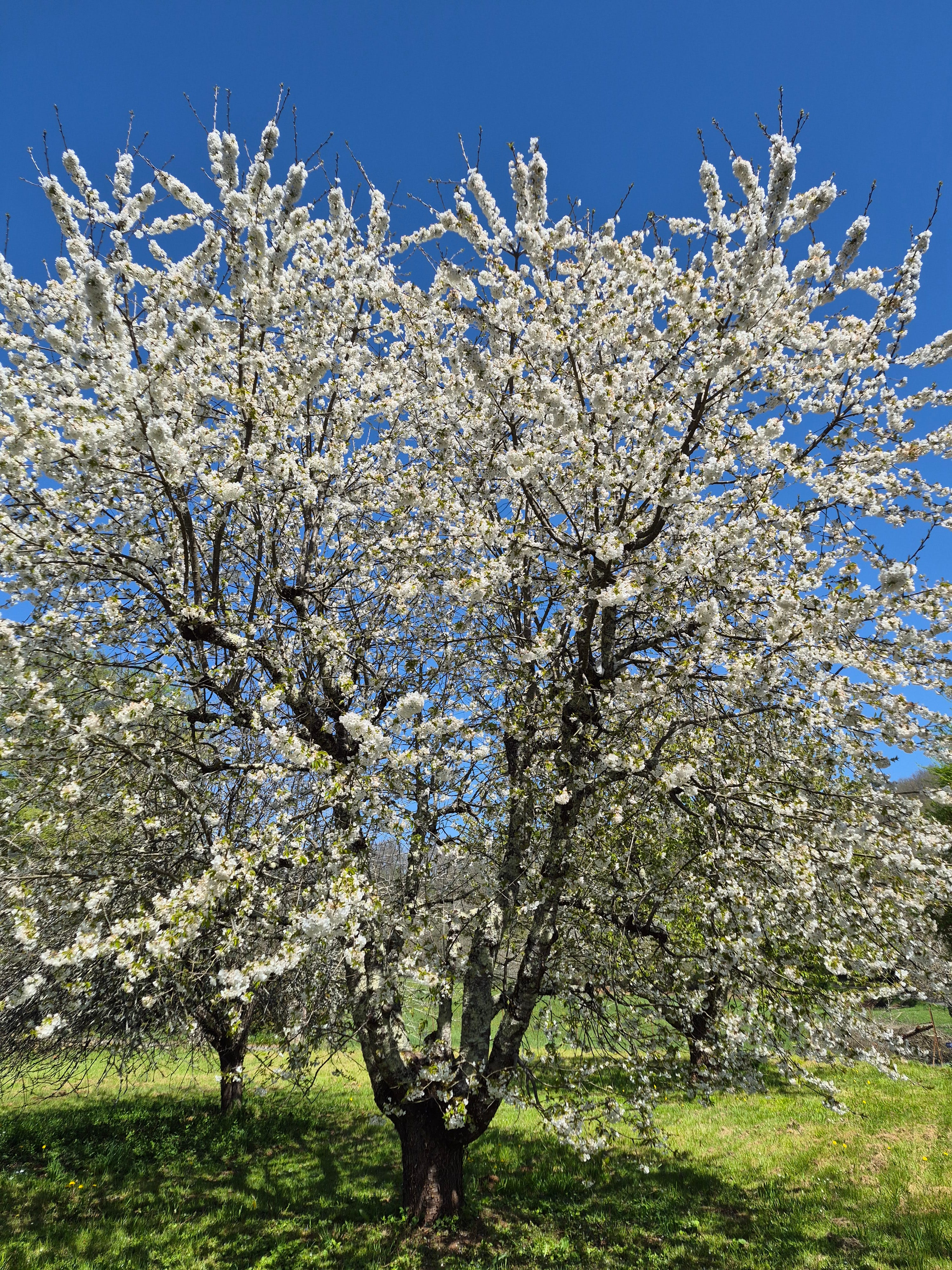
A few days ago, as I was rambling through a neighbouring village, I saw such a swing on the branch of a cherry tree in full bloom. A faint breeze transformed the white cherry blossoms into snow flakes as they sifted down on the overgrown grass of a neglected garden. The swing was slightly rocking, as if a ghost child was using it. It was a scene from a dream, depicting an idealised childhood, and my own younger self was the ghost on the swing.
They say it´s never too late to have a happy childhood. My childhood was not unhappy, but that swing among the floating cherry blossoms was a moment of the purest possible childhood happiness. Even it it was only in my imagination, more than half a century after my childhood.
(♥️- not me rushing to check my calendar, and my phonebook to see who I can invite over for an asparagus and magnolia platter because teenagers in my house wouldn’t but it’s the season to try out new foods. Alas, the magnolias are now officually over so best I head to the forest for l’ail des ours to pickle those little buds 😊)
Lovely piece! MacGuffins and Cherry blossoms! I wonder sometimes if Gatsby’s desire for Daisy isn’t a MacGuffin?